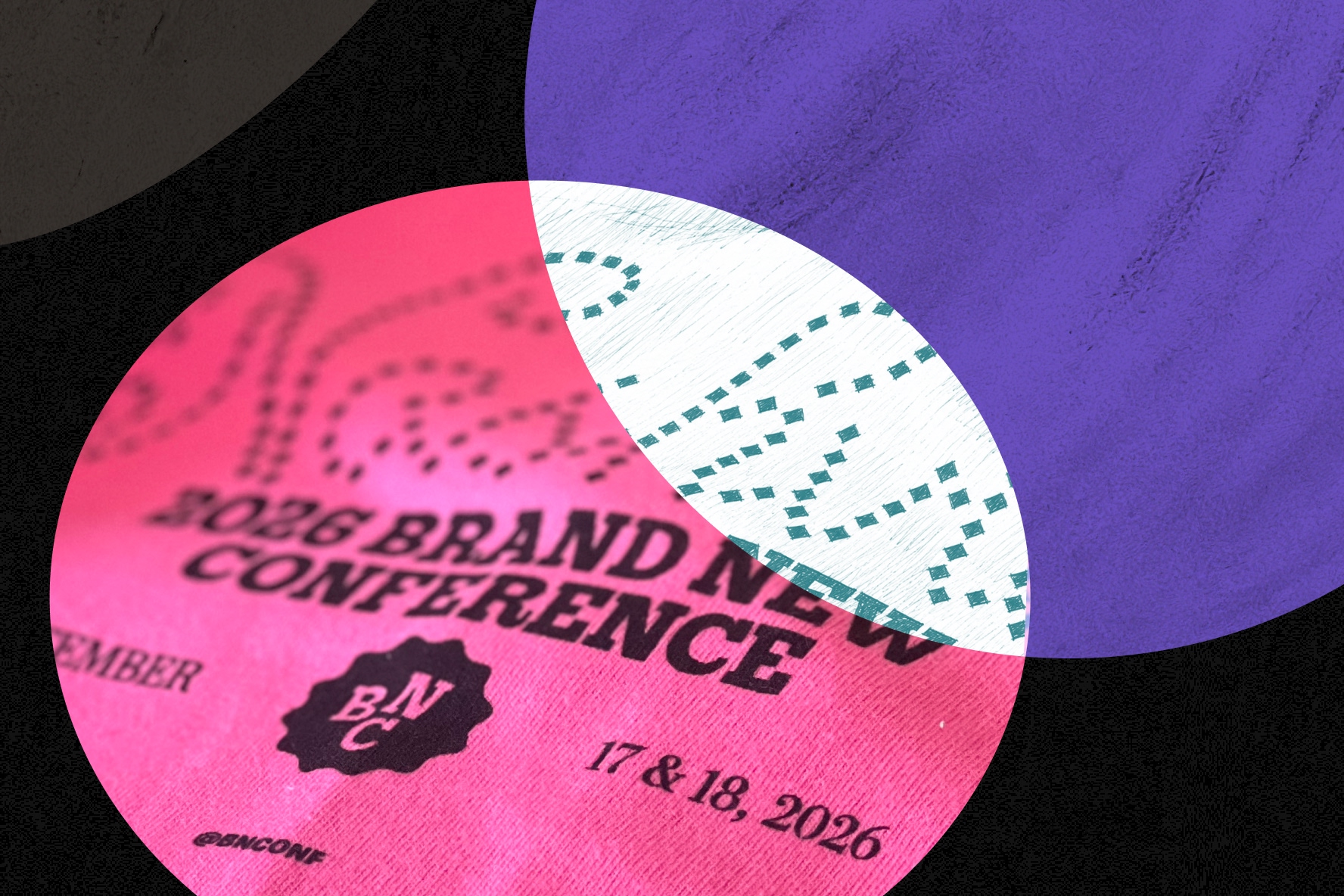
Our Brand Design team recently spent the week in Nashville for BrandNew 2026, surrounded by some of the most talented creatives around the world.
What made the event even more striking was the context of our current moment. Shifting cultural and geopolitical landscapes. An endless stream of AI headlines. And, somehow, the loss of Dolly Parton.
Put simply, there are few guarantees right now, and “Jolene” sounds a little sadder than it used to.
That uncertainty doesn’t stop at the doors of our boardrooms or disappear when we open a creative brief. The people we design for are navigating it, too.
Yet, what’s fascinating is that successful brand design work exists not in spite of these world affairs, but because of them.
Again and again, we saw creatives question familiar answers, embrace uncertainty, and make room for ideas that weren’t necessarily the easiest or most comfortable choice.
Here’s what that taught us about discomfort as a creative tool—and why a little unease might be exactly what brands need right now.
The Problem with Comfortable Brands
Historically, brands, particularly in tech, have followed a formula:
Trendy logo + Aspirational copy + Sleek, clean product photography = Successful Brand
Brands are comfortable here. It’s tried and true, but the playbook is being thrown by two new factors:
- Design is easier to make than ever.
- The world is more unpredictable than ever.
In 2026, the traditional brand playbook is still everywhere. But simply looking polished isn’t enough to stand out anymore.
Audiences are asking harder questions of the brands competing for their attention:
- What about this brand is human?
- Why should I believe what you say?
- How can I see myself in this product or service?
- Are you really any different?
Let’s get right out in front of it: these questions are uncomfortable, and they are certainly not easy to answer.
Comfortability tells us to ignore them and carry on.
The Cost of Comfort is Apathy
The hard truth is that an aesthetic can be generated in seconds.
AI knows the traditional brand playbook, and it feeds it to us in droves. Generative design tools churn out concepts faster than we can fully form an idea. Large language models throw us finished headlines before we even know what we’re really trying to say.
And if we’re being honest, we know that our audiences also know this playbook, too. They see it everywhere, from their smartphone apps and consumer labels to the endless stream of brands that can manufacture an aesthetic faster than they can give us a reason to care.
I’ve heard countless times that what will now distinguish human-made design is taste.
I disagree.
The challenge for human designers, and the thing that is already setting us apart, is our willingness to do the unexpected. To revel in detail over efficiency, to prioritize connection over reach, and to encounter difficult, sometimes existential questions about ourselves with openness and curiosity.
To be uncomfortable.
Discomfort in Action
One of my favorite moments from BrandNew 2026 came from Carissa Justice’s session on brand voice. Alongside a phenomenal manifesto entitled ‘Notes on Getting Lost’, which detailed the importance of embracing uncertainty in the creative process, Justice shared a peek behind the curtain at Taara, a Google-backed internet provider.
At its outset, Taara sounded like other products in its category: a fiber-like internet provider that used lasers to transmit internet to remote areas of the world.
On the surface, they needed a new way to talk about lasers that didn’t sound like their competitors.
But digging further into the project, Justice quickly found herself asking bigger, more uncomfortable questions:
- Is “lasers” the right way to describe Taara’s technology?
- What future is Taara striving for?
The result was a brand built around light, not lasers. Taara’s messaging reframed the technology through that lens, while its visual identity drew from the solar hues of dawn. Instead of saying something different, they started a new conversation.
Another highlight was Lasso Studio’s 15-minute crash course on the art of play, inspired by the studio duo’s children.
After presenting the work they did for Nashville’s 2020 Design Week, they accurately described the real-world constraints of creative work: the need for control, a stable income, and even the desire for a house to be perfectly in order.
Yet, they kept coming back to the success of this project and found that, underneath it all, the thing that made it different was play.
Unlike in other projects, they gave themselves the freedom to create boundlessly, using their respective superpowers in illustration and animation to build a brand that still generates leads to this day.
This wasn’t time-efficient, and it certainly didn’t come with a productivity-first mindset.
For both Taara and Lasso Studio, the strongest work came from resisting the temptation to stay comfortable. To say what everyone else was saying. To prioritize control. To choose the obvious answer because it was easier to defend.
Instead, they gave themselves permission to go somewhere less certain.
And the result was work that sang above the noise.
Choose Discomfort
Our world is not a convenient place. It’s unpredictable, imperfect, and increasingly difficult to distill into a clean creative brief.
In our attempt to make it convenient anyway, we are alienating ourselves from our audience.
Work that looks normal, sounds normal, and says the normal things ends up dead upon arrival.
The alternative isn’t another tool, trend, or playbook. It’s a willingness to sit with the questions that don’t have obvious answers. To follow an idea before we know exactly where it leads. To make something that might feel a little uncomfortable at first.
And unlike most creative tools in 2026, discomfort doesn’t require a $20 monthly payment to Anthropic.
It just takes the courage to try it.

