
When Jayson Manship wanted to understand what tools like Claude Design actually mean for organizations that do strategic product work, he reached out to TechPoint's Sally Reasoner. She pointed him to Mike Reynolds.
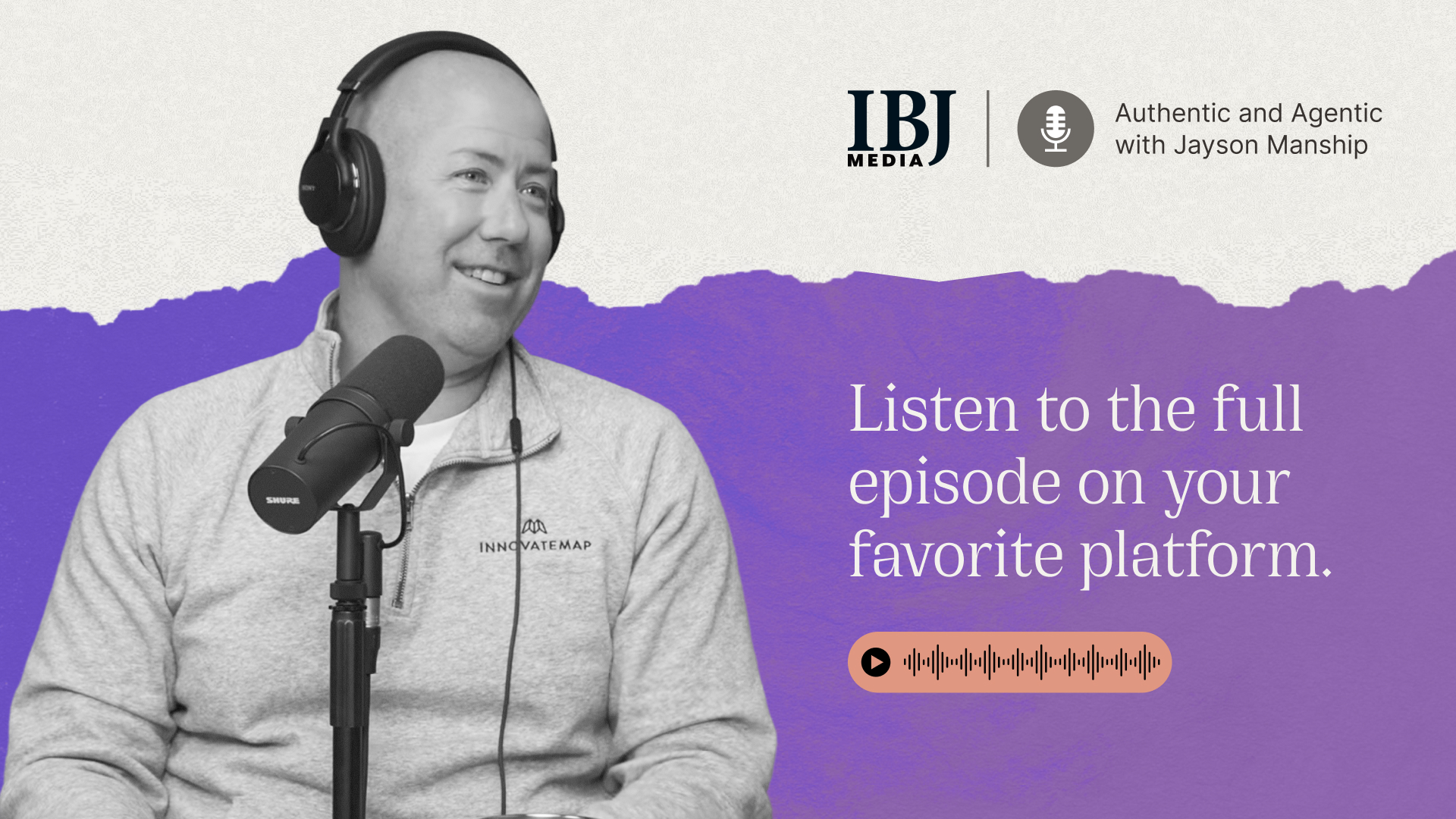
Mike is the CEO and founder of Innovatemap, and he joined Manship on Authentic and Agentic, a podcast that explores staying human in an increasingly automated world, for a conversation that covered a lot of ground: what companies get wrong when they try to move fast with AI, how AI fits into Innovatemap's work, and why human connection matters above all.
Listen to the full episode, but we covered the key takeaways below.
The Difference Between Building the Right Thing and Building the Thing Right
Mike shared a distinction he's spent three decades thinking about, and it gets easily lost in tech companies.
Engineers ask: are we building the thing right? They're focused on architecture, stability, quality, and integration. That's their job, and they're good at it.
Product teams ask: are we building the right thing? They're focused on whether the features they're prioritizing are actually valuable, whether the experience is usable without training, and whether what gets build can be clearly communicated to the market.
Both questions matter. But they're different questions. Conflating them is where a lot of companies run into trouble.
At Innovatemap, our product work spans all three phases:
- Product strategy — are we building the right thing?
- UX design — will people actually be able to use it?
- Go-to-Market — can we explain what we built in a way that resonates with buyers?
Separating any one of those from the others is where companies leave value on the table.
As he put it on the podcast, "If it's strategy and design related — helping this product resonate with users and resonate with buyers — that's what Innovatemap is going to help you do."
Outcome-Based Pricing: What 13 Years of Experience Looks Like
We don’t bill by the hour. Never have.
Mike made the shift to outcome-based pricing when he founded the company in 2014, drawing on his background in agile software delivery. The logic was simple, hourly billing misaligns incentives. It measures effort, not results. And it turns clients into auditors rather than partners.
The packaging of outcome-based pricing, Mike said, is actually the easy part. The harder work is internal. Building the systems, scoping the work, managing capacity and velocity with enough rigor that you can make and keep commitments without constant renegotiation.
That took years. And now, as more services companies scramble to move away from hourly billing because AI is making time-tracking feel increasingly indefensible, Innovatemap already has the infrastructure to deliver on it.
The model also shapes how clients relate to the team. Many clients treat the engagement the way they'd treat an embedded part of their team. They align on outcomes, they work hand in hand, and they trust us to get it done. That's not a vendor relationship. It's a partnership.
Three Ways AI is Impacting Innovatemap
Mike breaks down AI's impact on Innovatemap into three clear lenses.
Internal adoption. How are we using AI to get better at what we already do?
The emphasis here is on letting curiosity and experimentation lead, not mandating tools from the top down. We’ve been running a weekly Monday morning "AI show and tell" for over a year, a standing slot in the all-hands where anyone on the team can share something they've tried, something that worked, something that didn't. It's team-driven learning at a pace the team actually controls. Every Monday for more than a year, someone has shown up with something new.
Offerings evolution. How is AI changing what clients need from us?
Mike is clear about what AI can't replace — innovation, strategy, and creativity. Those three things happen to be exactly what Innovatemap does. Some services have shifted. Like how early-stage prototyping and clickable mockups can now be roughed out with AI tools. But the demand for work that requires real judgment like product strategy, user workflows, and go-to-market positioning hasn't changed. If anything, it's grown.
Client impact. How is AI affecting the companies we serve?
The range is wide. Some clients are just getting started and leaning on Innovatemap's pattern recognition across 40+ engagements annually to help them move smarter. Others went fast, hit walls, and are now doing the foundational work they skipped the first time around. What's consistent across both: the companies getting the most out of AI are the ones who got their house in order first.
The Real Problem with "Going All In on AI"
Mike shared a quote he'd heard recently, "AI isn't overhyped. But using it as a strategy is." The tools are real. The opportunity is real. But treating AI as a destination rather than an accelerant is where companies run into serious trouble.
Too often, we see companies trying to use AI tools on top of a flawed product experience. If your UX is broken, feeding it into Claude Design or any other tool doesn't fix it. It just produces more broken UX, faster.
The same dynamic plays out on the go-to-market side. If you want AI to help you produce more content, you need brand guidelines and a positioning foundation worth scaling first. Without that, the content AI generates doesn't reflect anything coherent. No amount of output volume fixes an unclear message.
The work Innovatemap is getting hired for right now, for both product experience and go-to-market, often comes down to a simple concept. Get your house in order so the AI actually works.
On Judgment, Creativity, and What Can't Be Automated
Mike believes AI raises the value of the things that are hardest to automate: innovation, strategy, and creativity.
AI can accelerate output. It can generate concepts, produce designs, and draft content. But someone still has to make the judgment call on whether that output is any good — whether it's on-brand, whether it solves the right problem, whether it's actually what the user needs.
That judgment is worth more now. When anyone can generate a design or a piece of copy in seconds, the person who can evaluate whether it's right becomes the differentiator.
There is a new premium on original and authentic design that stands out from what AI tools produce on their own. Rather than outsourcing creativity to AI, our team uses the tools to elevate what they do in a way they never could before.
Like Mike said, "Adobe didn't end creativity when it replaced drawing by hand. It accelerated it." The same logic applies.
On Human Connection and What Actually Keeps Him Up at Night
Manship asked what keeps Mike up at night. His answer shifted from professional to personal.
Not AI replacing jobs. Not the technology itself. What he worries about is companionship, the slow erosion of genuine human connection as more people turn to AI-powered tools to fill social and emotional needs.
Mike's prescription is direct, yet simple. Manage your screen time. Protect the things that fill your cup — relationships, faith, experiences, games across a table from someone you enjoy.
Those things don't get automated, and they're not supposed to.
Listen to the full episode with Mike and Jayson.
Authentic and Agentic is hosted by Jayson Manship and produced in partnership with TechPoint.The show explores the intersection of technology, leadership, and staying human in an increasingly automated world.

